The decision to award Bob Dylan the Nobel Prize for Literature is one that has ruffled a few feathers in the poetry world. Judging by my Facebook feed, at least, it also seems to have reignited the ages-old row about just what constitutes poetry anyway. After all, Dylan wrote songs, not literary works. Is there anything in his lyrics which justifies them being read in the way one might read a collection of poetry?
Some of Dylan’s detractors are comfortable with the concept of ‘Dylan as poet’, but can’t help asking was he really so much greater a poet than his contemporaries that he deserved a Nobel Prize when, for example, Joni Mitchell or Leonard Cohen didn’t? Cohen, after all, was a poet; he only became a songwriter by accident when he realised he could make far more money selling his poems by putting them to music than he could by publishing them as purely written collections. Others take a much more purist approach. Song lyrics, they argue, are not poetry, but a separate artform altogether. They are written for an entirely different purpose. They get away with things that would be unforgiveable in true ‘page’ poetry: trite rhymes, faltering scansion, cliché, wilful obscurity under the guise of psychedelic whimsy. And Dylan, in the course of his vast repertoire, has probably been guilty of all of the above, somewhere along the line. So is it really fair to true poets to put Dylan on the same pedestal as, for example, WB Yeats or Seamus Heaney by giving him a Nobel Prize for his writing?
Those in the pro-Dylan camp are more generous in their assessment of whether or not his song lyrics qualify as poetry. Some go so far as to assert that they are more accessible poetic works than most of the stuff that has been published under the auspices of poetry in his lifetime. They note the impact of his early protest songs on the global peace movement, the powerful social commentary and satire in many of his later writings. They point to the heartbreak of Blood on the Tracks and ask: well, isn’t such a paean to Love Gone Wrong precisely the stuff that poetry is made of? Where the pro-Dylan camp often falters is that they state this in such effusive terms as to suggest that Dylan never wrote a duff rhyme or a wilfully obscure metaphor in his life – a suggestion that, even as a fan, I have to admit is ridiculous.
So: was Bob writing poetry or not? And just what is poetry anyway? One of my correspondents noted, somewhat gleefully, that poets themselves (and free verse poets especially) are often painfully inconsistent on this very subject. “There are no rules – anything goes!” they triumphantly declare one moment – the next, they’ll be adamant that (for example) one of Bob Dylan’s song lyrics isn’t poetry because it has an inconsistent rhyme scheme/irregular scansion/doesn’t look like a poem on the page. My correspondent tells me that he has had great fun recently posting up pieces of prose on his Write Out Loud blog and waiting for the avalanche of criticisms that “that’s not a poem!”
I tend to take a liberal approach to what is and isn’t a poem. Basically, if the person who wrote it says it’s a poem, then who am I to argue? That doesn’t necessarily mean that the piece of writing exhibits poetic qualities. Many poems (or pieces of writing that are presented as poems) aren’t especially poetic. I suspect that my correspondent’s mischievous prose offerings may well fall into this category. But if the writer asserts that they want their work to be approached in the way that one would approach a poem, then as far as I’m concerned it doesn’t matter whether it is presented as a sonnet, a song lyric, a rambling piece of free verse, or as prose. If there are poetic qualities in the writing, these should sing out. If there aren’t – or if there are features of the writing which clash with any poetic qualities – these will probably stand out too.
A piece of writing needn’t be presented as poetry to have poetic qualities. The prose of George Mackay Brown, for example, contains some of the most intensely poetic writing I have ever had the privilege to read. The flash fiction of writers like Steve Toase and Amal el-Mohtar is often so richly poetic that it can be a surprise to see it laid out on the page in paragraphs instead of stanzas. Some of my favourite songwriters – a gamut that ranges from Paul Simon to Jarvis Cocker, with Dylan somewhere in the mix – have a brilliantly poetic ear for a good lyric. Others don’t, but are no less great songwriters for all that. Kate Bush, for example, only rarely produces lyrics with a true poetic flair – but she’s a musician’s musician, far more interested in the sonic qualities of the music as a whole (words, accompaniment, rhythm and effects) than in the fine craft of rhyme and meter. It all depends on the writer’s intention for their composition.
So the question isn’t really “is it poetry?” The question that interests me far more is “does it have poetic qualities?” If the answer is yes, then the writing deserves recognition – be that a Nobel Prize or a round of applause at the local open mic.
And what constitute “poetic qualities”? I’ll happily throw some ideas out here. Poetic writing, for me, is a distillation – an attempt to convey intense experiences and sensations in as few words as possible. It does this by employing literary devices such as imagery and subtext to point at meanings beyond the literal text of the words themselves. And perhaps above all, it does this using a musicality of language which reinforces the mood and creates emotional resonances of its own.
I plan to look at these ideas in a bit more depth in future blog posts.
As for whether Dylan himself is a poet: I have no intention of answering that. You'll just have to weigh up the evidence and decide for yourselves.
Showing posts with label songwriting. Show all posts
Saturday, 31 December 2016
Thursday, 10 March 2016
Don't Pay the Ferryman, or The Perils of the "Greatest Hit"
As results day for the National Poetry Competition approaches, and the deadline for this year’s Bridport Prize looms, I have no doubt there are many up-and-coming poets dreaming of how one of these prizes could change their lives. If you’re one of them, I don’t blame you. The poetry world is such a thankless one for so much of the time that frankly any kind of recognition from the establishment is cause for celebration. A win in the Bridport or the National could even be career-changing, as the likes of Carol Ann Duffy and Colette Bryce can testify.
But a big win like this could be something of a poisoned chalice, in its own way.
I do enter these competitions, from time to time. Well, OK, not Bridport – I’ve blogged before about why not – but I try and use my Poetry Society member’s free entry to the National every year. Yet when I do, there’s still a lurking fear that any dreams of success could mutate all too easily into nightmares. That, in short, a big win could turn me into the poetic equivalent of Chris de Burgh.
For the benefit of my younger readers, allow me to explain. Back when I were a lad, before middle age and cynicism set in, there was a badly dressed troubadour whose songwriting I followed avidly. He lived in a castle. He had eyebrows like two large Tiger Moth caterpillars. And he was the nearest modern equivalent to the travelling minstrels of medieval times, wandering the countryside with his repertoire of fairy tales and murder ballads. They were quirky, subversive, rude and occasionally iconoclastic – and I loved them. I still remember, as an impressionable schoolboy, the shiver that went through me the first time I listened to Spanish Train. A song about God and the Devil playing poker for souls – not the sort of theology I was usually exposed to by the Christian Brothers! I remember singing duets with my brother, staggering half-drunk through the streets of Birkenhead, on the way home from some party or other: oh the leaves are falling and the wind is calling and I must get on the road. I was never all that rebellious in my youth; but somehow blasting out Patricia the Stripper on the sixth-form ghetto blaster when the head of year walked past seemed to make up quite nicely for all the absinthe, marijuana and fornication that I never had the nerve to attempt. To this day, if you catch me at the wrong moment after a beer or two too many, I can treat you to a full rendition.
You see, back in the day, Chris de Burgh was actually rather good. He was like me: a compulsive storyteller. He was fascinated by fairy stories. He sang some of the best peace songs ever written. Occasionally he was really rude, in a naive, Benny Hill, chasing-scantily-clad-women-in-circles-round-the-nearest-tree kind of way. My brother, the metal-head, used to play the Apocalypse Cycle from Into the Light at full volume in his hall of residence, and fellow students really thought it was the next big thing in heavy metal. Chris de Burgh could be all things to all people.
But then it happened. This bard with the razor wit and the rainbow voice went and had a hit. A huge hit.
Yes, with a twitch of one megalithic eyebrow, de Burgh secured his fortune for the rest of his life. And buried his career with it.
Now this is the problem. Ardent follower though I am, I have to confess that nine times out of ten, the reaction I get at the mention of Chris de Burgh (apart from “Who?”), is “Wasn’t The Lady in Red a pile of shite?” It doesn’t matter how much I talk about the radical back catalogue: the songs about strippers, or murderers, or celestial poker games. “Wasn’t The Lady in Red a pile of shite?” is all I hear. Unless I’m talking to a blue-rinsed Daily Mail reader, at which point I get really hot under the collar, because CHRIS DE BURGH WAS NEVER MEANT TO BE ENJOYED BY BLUE-RINSED DAILY MAIL READERS!
There we have it: the curse of the “greatest hit”. One big success, and you can be pigeon-holed for life. You may spend the remainder of your creative career trying to replicate the magic formula – and kill off your creativity in the process. Think of all the great novelists who produced one successful novel in their lifetimes, and never published anything thereafter because they simply couldn’t come close to recapturing the magic of that first triumph. Or the ones who had a big success and followed it up with dozens of sub-standard re-runs. Or the ones forced into doing something so radically different that their original fans are left baffled and alienated, and who never quite win new ones.
There’s also the risk that even if you do follow up the “greatest hit” with something wonderful, the public just won’t want to know. Another of my favourite hippie troubadours, Ralph McTell, suffers from this more than most. He may have a good 45 years’ worth of wonderful songwriting under his belt but he's still expected to wheel out Streets of London at every opportunity. “Streets of London Syndrome” was brilliantly lampooned by the Big Train team back in the 1990s, but there’s a truth behind the joke. I know one award-winning poet who loathes his “greatest hit” with a passion, but has to perform it at every single gig because this is what the audience demand.
I’ve got to be honest. I can’t really defend The Lady in Red. The best I can do is point out the injustice that plenty of far more “credible” musicians have recorded far worse songs, and somehow kept their reputations intact while de Burgh’s has been ground into the mire. On a sliding scale of awfulness, The Lady in Red might score a full 9 out of 10, but Wonderful Tonight – quite possibly the most nauseating song ever written? – merits at least 30,000: and yet there are still people who claim that Eric Clapton is God! And what about Stevie Wonder? A songwriting genius, it’s true; but why is he allowed to get away with the sentimental bilge that is I Just Called to Say I Love You, while de Burgh gets pilloried for an inconsequential little ditty about his ex-wife’s red dress? It doesn’t matter how much I protest that The Lady in Red was an aberration, that he shouldn’t be judged on the strength of one embarrassing song. Judged he is, and probably always will be.
This is why I dread becoming Chris de Burgh. It’s the lurking fear that, were I to have a big hit sometime in my poetic career, it will be the start of a slippery slope. That I’ll cash in. I’ll sell out. Or else I’ll yearn to do something different, but won’t be able to get gigs unless I keep performing the same old “classic”. I dread that one day I’ll make one concession too many, and everything worthwhile that I’ve ever done and stood for will be lost in a single act of all-consuming mediocrity.
I’m going to go on protesting the greatness of Chris de Burgh. Every few years he’ll create a peace song of epic proportions, and remind me exactly why I used to revere him. The trouble is that for every Up Here in Heaven or The Last Time I Cried there are a dozen unnecessary re-runs of The Lady in Red. And they don’t exactly help my case.
I try not to get too despondent. I still want to believe that in years to come, the reputation of Chris de Burgh will be redeemed – that our children’s children will be able to sing his songs the way I used to sing them, with sparkling eyes. But in the meantime I feel the tug of an expanding waistline. I catch a whiff of that expensive malt whisky I never used to be able to afford. And I know that if I ever wrote the literary equivalent of The Lady in Red, I would probably go the way of Chris de Burgh.
So don’t pay the ferryman, ladies and gentlemen. Don’t even fix a price.
But a big win like this could be something of a poisoned chalice, in its own way.
I do enter these competitions, from time to time. Well, OK, not Bridport – I’ve blogged before about why not – but I try and use my Poetry Society member’s free entry to the National every year. Yet when I do, there’s still a lurking fear that any dreams of success could mutate all too easily into nightmares. That, in short, a big win could turn me into the poetic equivalent of Chris de Burgh.
For the benefit of my younger readers, allow me to explain. Back when I were a lad, before middle age and cynicism set in, there was a badly dressed troubadour whose songwriting I followed avidly. He lived in a castle. He had eyebrows like two large Tiger Moth caterpillars. And he was the nearest modern equivalent to the travelling minstrels of medieval times, wandering the countryside with his repertoire of fairy tales and murder ballads. They were quirky, subversive, rude and occasionally iconoclastic – and I loved them. I still remember, as an impressionable schoolboy, the shiver that went through me the first time I listened to Spanish Train. A song about God and the Devil playing poker for souls – not the sort of theology I was usually exposed to by the Christian Brothers! I remember singing duets with my brother, staggering half-drunk through the streets of Birkenhead, on the way home from some party or other: oh the leaves are falling and the wind is calling and I must get on the road. I was never all that rebellious in my youth; but somehow blasting out Patricia the Stripper on the sixth-form ghetto blaster when the head of year walked past seemed to make up quite nicely for all the absinthe, marijuana and fornication that I never had the nerve to attempt. To this day, if you catch me at the wrong moment after a beer or two too many, I can treat you to a full rendition.
You see, back in the day, Chris de Burgh was actually rather good. He was like me: a compulsive storyteller. He was fascinated by fairy stories. He sang some of the best peace songs ever written. Occasionally he was really rude, in a naive, Benny Hill, chasing-scantily-clad-women-in-circles-round-the-nearest-tree kind of way. My brother, the metal-head, used to play the Apocalypse Cycle from Into the Light at full volume in his hall of residence, and fellow students really thought it was the next big thing in heavy metal. Chris de Burgh could be all things to all people.
But then it happened. This bard with the razor wit and the rainbow voice went and had a hit. A huge hit.
Yes, with a twitch of one megalithic eyebrow, de Burgh secured his fortune for the rest of his life. And buried his career with it.
Now this is the problem. Ardent follower though I am, I have to confess that nine times out of ten, the reaction I get at the mention of Chris de Burgh (apart from “Who?”), is “Wasn’t The Lady in Red a pile of shite?” It doesn’t matter how much I talk about the radical back catalogue: the songs about strippers, or murderers, or celestial poker games. “Wasn’t The Lady in Red a pile of shite?” is all I hear. Unless I’m talking to a blue-rinsed Daily Mail reader, at which point I get really hot under the collar, because CHRIS DE BURGH WAS NEVER MEANT TO BE ENJOYED BY BLUE-RINSED DAILY MAIL READERS!
There we have it: the curse of the “greatest hit”. One big success, and you can be pigeon-holed for life. You may spend the remainder of your creative career trying to replicate the magic formula – and kill off your creativity in the process. Think of all the great novelists who produced one successful novel in their lifetimes, and never published anything thereafter because they simply couldn’t come close to recapturing the magic of that first triumph. Or the ones who had a big success and followed it up with dozens of sub-standard re-runs. Or the ones forced into doing something so radically different that their original fans are left baffled and alienated, and who never quite win new ones.
There’s also the risk that even if you do follow up the “greatest hit” with something wonderful, the public just won’t want to know. Another of my favourite hippie troubadours, Ralph McTell, suffers from this more than most. He may have a good 45 years’ worth of wonderful songwriting under his belt but he's still expected to wheel out Streets of London at every opportunity. “Streets of London Syndrome” was brilliantly lampooned by the Big Train team back in the 1990s, but there’s a truth behind the joke. I know one award-winning poet who loathes his “greatest hit” with a passion, but has to perform it at every single gig because this is what the audience demand.
I’ve got to be honest. I can’t really defend The Lady in Red. The best I can do is point out the injustice that plenty of far more “credible” musicians have recorded far worse songs, and somehow kept their reputations intact while de Burgh’s has been ground into the mire. On a sliding scale of awfulness, The Lady in Red might score a full 9 out of 10, but Wonderful Tonight – quite possibly the most nauseating song ever written? – merits at least 30,000: and yet there are still people who claim that Eric Clapton is God! And what about Stevie Wonder? A songwriting genius, it’s true; but why is he allowed to get away with the sentimental bilge that is I Just Called to Say I Love You, while de Burgh gets pilloried for an inconsequential little ditty about his ex-wife’s red dress? It doesn’t matter how much I protest that The Lady in Red was an aberration, that he shouldn’t be judged on the strength of one embarrassing song. Judged he is, and probably always will be.
This is why I dread becoming Chris de Burgh. It’s the lurking fear that, were I to have a big hit sometime in my poetic career, it will be the start of a slippery slope. That I’ll cash in. I’ll sell out. Or else I’ll yearn to do something different, but won’t be able to get gigs unless I keep performing the same old “classic”. I dread that one day I’ll make one concession too many, and everything worthwhile that I’ve ever done and stood for will be lost in a single act of all-consuming mediocrity.
I’m going to go on protesting the greatness of Chris de Burgh. Every few years he’ll create a peace song of epic proportions, and remind me exactly why I used to revere him. The trouble is that for every Up Here in Heaven or The Last Time I Cried there are a dozen unnecessary re-runs of The Lady in Red. And they don’t exactly help my case.
I try not to get too despondent. I still want to believe that in years to come, the reputation of Chris de Burgh will be redeemed – that our children’s children will be able to sing his songs the way I used to sing them, with sparkling eyes. But in the meantime I feel the tug of an expanding waistline. I catch a whiff of that expensive malt whisky I never used to be able to afford. And I know that if I ever wrote the literary equivalent of The Lady in Red, I would probably go the way of Chris de Burgh.
So don’t pay the ferryman, ladies and gentlemen. Don’t even fix a price.
Thursday, 28 November 2013
For Your Eldorado - a tribute to Graeme Miles
It's always a rather awe-inspiring moment when a poem escapes the clutches of the poet and takes on a life of its own, beyond the creator. A few days ago I had the honour of hearing my poem For Your Eldorado read out at a packed concert in celebration of a great songwriter, social chronicler, and one of the first people ever to champion my own writing.
In his inimitable, quiet way, Graeme Miles is something of a local legend in the north-east of England. In a period of just over 20 years spanning the 1950s and 60s, he wrote 300-odd songs chronicling the landscape and the changing way of life in the Teesside where he grew up, lived and worked. A disciple of the Folk Revival, Graeme's songwriting was heavily influenced by the traditional music of the area. Many of his songs are shared and passed around Teesside today as if they were true folk songs, or nursery rhymes.
Graeme Miles passed away earlier this year without ever becoming a mainstream name in the arts world. He'd never have wanted such recognition. He was humble, dignified and self-effacing. For Graeme, the created work mattered far more than the creator. When traditional ways of life were coming to an end, and changing economic fortunes were dealing hammer-blows to the established industry of the region, Graeme saw his songs as his contribution to a shared heritage, a collective memory capable of withstanding the changes all around.
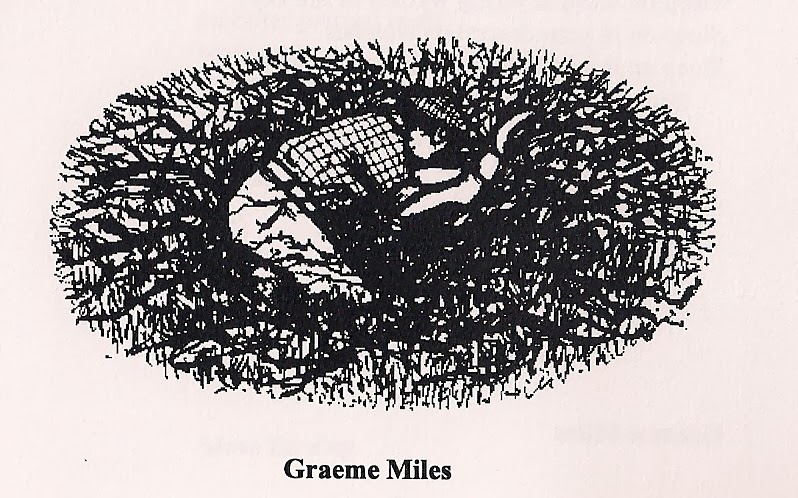
I had the great privilege of getting to know Graeme very early in my journey as a poet. Some fifteen years ago, I became a member of Jackdaw, an informal little poetry circle in Durham, which was attended by Graeme and his artistic collaborator Robin Dale. Graeme was the quiet member of the group, but his creativity was clear from the start. He was an aspiring poet, striving to write “good, bad and indifferent verse, but not necessarily in that order” (his words). He produced a series of wonderful illustrations for the first Jackdaw anthology (including the magnificent cover picture that graces this article). And it was through Robin's haunting performances of Graeme's songs that I first got to know his incredible back catalogue. Pastoral poems, work songs, chronicles of changing times: it seemed Graeme had written them all.
I had no idea how far Graeme's music had travelled until I started to venture into the idiosyncratic world of the region's folk clubs. It was a surprise to me just how many musicians – from fireside amateurs to bona-fide, touring professionals – had Graeme's songs in their repertoire. They had a natural home in north-east England, but many were known across the length of the UK (and even beyond; another exponent, Martyn Wyndham-Read, has exported the Graeme Miles songbook all the way to Australia!). I once heard Bob Fox sing The Shores of Old Blighty to a field of 10,000 people at the Cropredy Festival – and most of those 10,000 joined in the refrain.
What makes Graeme's songs special isn't just their role as sociological record. These are songs with immense heart: poems-set-to-music which are filled with love and loss, dreams of peace and hope for a better tomorrow. As a writer, Graeme was always among the people. He took on back-breaking manual labour in order to celebrate the labourers in song. He slept rough in the bitter winter of 1963. He walked the long march from Aldermaston with the original Campaign for Nuclear Disarmament. His songwriting was political, but not in any contrived or self-important way. His depiction of the wind across the North York Moors in Horumarye may have been intended to salute the timeless pilgrims of the Lyke Wake Walk; but when he sang “Cold blows the wind over Fylingdales”, it was impossible for a listener not to form a mental image of the frightening outpost of Cold War paranoia that dominated the landscape in Graeme's own lifetime. He could discuss world peace in grand allegory in The Eagle and the Dove, or through the simple dreams of a conscripted squaddie wishing for The Shores of Old Blighty.
I didn't know it at the time, but Graeme had known his share of romance, and romance gone wrong, in his younger days too. His first love song – the enigmatically titled Exercise no. 77 (only recently re-catalogued as the much more poetic Amouret) – is one of the finest pieces of romantic poetry I know. Perhaps this is one of the reasons that Graeme and I first became friends. At a turbulent time in my own private life, Graeme understood the subtext in my poetry, and encouraged me not to be afraid to express what I was feeling. He even illustrated a couple of those early attempts.
And this is where I owe Graeme a real debt. I'd only been writing poetry a couple of years when I joined the Jackdaws. But very early on, Graeme found a point of connection with my writing, and became a generous champion. I was still far from the point of actually submitting my work for publication; but it's in no small measure down to the confidence that Graeme always placed in me and my writing, that I was eventually able to do so. Perhaps it was because we shared subject matter – the natural world, love and heartbreak, occasional political comment. More likely, it was just because he was a generous, thoughtful man, keen to nurture creativity wherever he found it. He was scathing in his dismissal of the fake and the superficial. But when he found something genuine, he was passionate in his nurturing of it.
Graeme and I corresponded for several years after I left Durham, and gradually became what I hesitatingly describe as “a serious poet”. One of my most treasured possessions is the signed copy of Songscapes, his first published volume of songs, which he gave to Kath and me as a wedding present. I've watched – admittedly at a distance, but with pride and delight – as Graeme's work has attracted serious recognition (notably from the English Folk Dance and Song Society) and new generations of musicians have declared their allegiance. The Unthanks, the master reinterpreters of north-eastern traditional music, and up-and-coming rabble-rousers The Young 'Uns, are just two of the bands who have found inspiration from Graeme's work and his outlook on his art.
News of Graeme's death earlier this year was, of course, a great sadness. But it was a fitting tribute to the man and his music that his devotees were able to fill Cecil Sharp House on 23rd November for a celebration of Graeme's legacy. The Unthanks, The Wilsons, Martyn Wyndham-Read, The Young 'Uns and even Robin Dale performed a wondrous mix from the vast Graeme Miles repertoire, from the simple solo voice (Robin's haunting rendition of Exercise no. 77 still sends shivers through me) to avant-garde arrangements with brass, fiddle and sample loops of Graeme's own voice reading his poetry.
My poem, For Your Eldorado, played a small part in the proceedings. Written in 2008, and taking its title from one of Graeme's best loved songs, the poem was my thank-you for his wonderful music and for the encouragement and inspiration over the years. By a circuitous route, the poem had managed to find its way into the hands of Martyn Wyndham-Read, who judged it fitting to be shared during the evening, and contacted me out of the blue to ask for permission for it to be read out.
I probably won't ever know what Graeme thought of the poem. I sent him a copy, back when it was fresh off the printer, but we had already lost touch by this point, and I didn't get a reply. I hope he appreciated it. For now, it stands as my tribute to a generous hearted, intelligent, wise and creative writer, and a gentleman of the first order. For me, Graeme Miles was and is a poet among poets. If my creative work can in some small measure live up to the example he has set, then I’ll be a very proud man indeed.
(All illustrations in this article are by Graeme Miles and appeared in the Jackdaw writers' anthology in 2000. The text of my poem For Your Eldorado can be found at http://www.graememiles.com/lyrics.)
(For more about Graeme and his music, visit http://www.graememiles.com)
In his inimitable, quiet way, Graeme Miles is something of a local legend in the north-east of England. In a period of just over 20 years spanning the 1950s and 60s, he wrote 300-odd songs chronicling the landscape and the changing way of life in the Teesside where he grew up, lived and worked. A disciple of the Folk Revival, Graeme's songwriting was heavily influenced by the traditional music of the area. Many of his songs are shared and passed around Teesside today as if they were true folk songs, or nursery rhymes.
Graeme Miles passed away earlier this year without ever becoming a mainstream name in the arts world. He'd never have wanted such recognition. He was humble, dignified and self-effacing. For Graeme, the created work mattered far more than the creator. When traditional ways of life were coming to an end, and changing economic fortunes were dealing hammer-blows to the established industry of the region, Graeme saw his songs as his contribution to a shared heritage, a collective memory capable of withstanding the changes all around.
I had the great privilege of getting to know Graeme very early in my journey as a poet. Some fifteen years ago, I became a member of Jackdaw, an informal little poetry circle in Durham, which was attended by Graeme and his artistic collaborator Robin Dale. Graeme was the quiet member of the group, but his creativity was clear from the start. He was an aspiring poet, striving to write “good, bad and indifferent verse, but not necessarily in that order” (his words). He produced a series of wonderful illustrations for the first Jackdaw anthology (including the magnificent cover picture that graces this article). And it was through Robin's haunting performances of Graeme's songs that I first got to know his incredible back catalogue. Pastoral poems, work songs, chronicles of changing times: it seemed Graeme had written them all.
I had no idea how far Graeme's music had travelled until I started to venture into the idiosyncratic world of the region's folk clubs. It was a surprise to me just how many musicians – from fireside amateurs to bona-fide, touring professionals – had Graeme's songs in their repertoire. They had a natural home in north-east England, but many were known across the length of the UK (and even beyond; another exponent, Martyn Wyndham-Read, has exported the Graeme Miles songbook all the way to Australia!). I once heard Bob Fox sing The Shores of Old Blighty to a field of 10,000 people at the Cropredy Festival – and most of those 10,000 joined in the refrain.
What makes Graeme's songs special isn't just their role as sociological record. These are songs with immense heart: poems-set-to-music which are filled with love and loss, dreams of peace and hope for a better tomorrow. As a writer, Graeme was always among the people. He took on back-breaking manual labour in order to celebrate the labourers in song. He slept rough in the bitter winter of 1963. He walked the long march from Aldermaston with the original Campaign for Nuclear Disarmament. His songwriting was political, but not in any contrived or self-important way. His depiction of the wind across the North York Moors in Horumarye may have been intended to salute the timeless pilgrims of the Lyke Wake Walk; but when he sang “Cold blows the wind over Fylingdales”, it was impossible for a listener not to form a mental image of the frightening outpost of Cold War paranoia that dominated the landscape in Graeme's own lifetime. He could discuss world peace in grand allegory in The Eagle and the Dove, or through the simple dreams of a conscripted squaddie wishing for The Shores of Old Blighty.
I didn't know it at the time, but Graeme had known his share of romance, and romance gone wrong, in his younger days too. His first love song – the enigmatically titled Exercise no. 77 (only recently re-catalogued as the much more poetic Amouret) – is one of the finest pieces of romantic poetry I know. Perhaps this is one of the reasons that Graeme and I first became friends. At a turbulent time in my own private life, Graeme understood the subtext in my poetry, and encouraged me not to be afraid to express what I was feeling. He even illustrated a couple of those early attempts.
And this is where I owe Graeme a real debt. I'd only been writing poetry a couple of years when I joined the Jackdaws. But very early on, Graeme found a point of connection with my writing, and became a generous champion. I was still far from the point of actually submitting my work for publication; but it's in no small measure down to the confidence that Graeme always placed in me and my writing, that I was eventually able to do so. Perhaps it was because we shared subject matter – the natural world, love and heartbreak, occasional political comment. More likely, it was just because he was a generous, thoughtful man, keen to nurture creativity wherever he found it. He was scathing in his dismissal of the fake and the superficial. But when he found something genuine, he was passionate in his nurturing of it.
Graeme and I corresponded for several years after I left Durham, and gradually became what I hesitatingly describe as “a serious poet”. One of my most treasured possessions is the signed copy of Songscapes, his first published volume of songs, which he gave to Kath and me as a wedding present. I've watched – admittedly at a distance, but with pride and delight – as Graeme's work has attracted serious recognition (notably from the English Folk Dance and Song Society) and new generations of musicians have declared their allegiance. The Unthanks, the master reinterpreters of north-eastern traditional music, and up-and-coming rabble-rousers The Young 'Uns, are just two of the bands who have found inspiration from Graeme's work and his outlook on his art.
News of Graeme's death earlier this year was, of course, a great sadness. But it was a fitting tribute to the man and his music that his devotees were able to fill Cecil Sharp House on 23rd November for a celebration of Graeme's legacy. The Unthanks, The Wilsons, Martyn Wyndham-Read, The Young 'Uns and even Robin Dale performed a wondrous mix from the vast Graeme Miles repertoire, from the simple solo voice (Robin's haunting rendition of Exercise no. 77 still sends shivers through me) to avant-garde arrangements with brass, fiddle and sample loops of Graeme's own voice reading his poetry.
My poem, For Your Eldorado, played a small part in the proceedings. Written in 2008, and taking its title from one of Graeme's best loved songs, the poem was my thank-you for his wonderful music and for the encouragement and inspiration over the years. By a circuitous route, the poem had managed to find its way into the hands of Martyn Wyndham-Read, who judged it fitting to be shared during the evening, and contacted me out of the blue to ask for permission for it to be read out.
I probably won't ever know what Graeme thought of the poem. I sent him a copy, back when it was fresh off the printer, but we had already lost touch by this point, and I didn't get a reply. I hope he appreciated it. For now, it stands as my tribute to a generous hearted, intelligent, wise and creative writer, and a gentleman of the first order. For me, Graeme Miles was and is a poet among poets. If my creative work can in some small measure live up to the example he has set, then I’ll be a very proud man indeed.
(All illustrations in this article are by Graeme Miles and appeared in the Jackdaw writers' anthology in 2000. The text of my poem For Your Eldorado can be found at http://www.graememiles.com/lyrics.)
(For more about Graeme and his music, visit http://www.graememiles.com)
Thursday, 18 April 2013
Poetry Transvestism, Part 2: are you Sounding Lyrical?
Recently I had the privilege of taking part in the inaugural concert of the Sounds Lyrical Project – a collaborative venture between a group of poets and a small team of classically trained composers who have set our poems to music. I've always loved classical recitals, and for the Project, a full-length evening concert of original work was a "yes we can" moment: it was proof that the concept of Sounds Lyrical has something going for it.But all of us, composers and poets alike, are aware that the Project won't get very far if we stick to this format.
A number of things struck me about the audience. One, there weren't all that many of them. Okay, fair enough – I've performed poetry to smaller crowds. What matters isn't so much the number of people turning up, but the quality of the experience they have when they do.
More striking than the numbers attending, though, was the proportion wearing what I would describe as "smart dress". Jackets and college scarves were the order of the day. Heck, I wore a jacket and college scarf. There was a practical reason for this (we were performing in a freezing cold chapel – why does this seem to be a recurring theme of my poetry gigs?!). But I was acutely aware that this isn't how I normally dress when I'm performing poetry. Jeans and T-shirt are more my style.
I don't think the audience were any posher than the crowd that used to turn out to hear me MC at Speakers' Corner. But there's clearly a feeling that a classical concert is a "special occasion" and requires a slightly higher standard of decorum than the average open mic. The need to dress smartly, to sit perfectly still for two hours in a cold chapel, not to shuffle feet or to cough, was clearly in evidence. Maybe this is the reason that concerts of this type (not to mention poetry readings of this type) tend not to attract large audiences?
The conversation at the pub afterwards explored this issue. One of the reasons the project was set up in the first place was to tackle an image problem within contemporary classical music. The intellectual elitism of Schoenberg and the European avant-garde, according to my composer friends, have done for modern composition what the pretentious poets of my recent blog post have done for contemporary poetry.
But, in composition at least, intellectualism is now on the wane. Composers these days, by and large, want to collaborate – to fuse genres and styles, to pick and mix from a melting pot that includes rock, jazz and world music as well as the European classical tradition. The opportunity to work with artists across a range of media also presents the chance to bring new music to audiences who wouldn't ever do the wear-a-jacket, sit-in-a-cold-chapel thing.
The ideal venue for our concert might well have been the pub we adjourned to afterwards. Not that we'd have wanted to ambush unsuspecting punters with a resonant baritone and the nifty fingerwork of a skilled professional pianist; but there was actually a piano in that pub, and no particular reason why the Project couldn't make use of it at some unspecified future date.
The advantage of "doing art" in an unconventional venue – a pub, cafe, railway station, or wherever – is that it opens up the art to people who wouldn't otherwise take a chance on it. Effort is needed to put on a jacket and sit in a cold chapel; but if you’re anything like me, you won't need all that much persuading to come along to your regular pub and stump up the price of an extra pint or two to try out something just a bit different. Especially not if beer, conversation and good company can all still be enjoyed into the bargain.
So where now for Sounds Lyrical? Our lead composers have been adventurous with their material, and in choosing to collaborate with an unruly group of poets. We need to be equally adventurous as to how and where we present that material. There are plenty of possibilities. When we lived in Birmingham, my wife and I sang in a choir who did more gigs in pubs than in concert halls. Their repertoire ranged from Britten and Barber to Abba and Queen (not to mention some extraordinary original compositions from members of the choir themselves). Their concerts were fun, accessible, and very different to any recitals I've ever attended.
This is the sort of model I would like Sounds Lyrical to aim at. I love to see poetry invading the public consciousness by showing up in unexpected places. And I'd love to hear modern classical music do the same.
Subscribe to:
Posts (Atom)