Wednesday, 2 July 2014
Poetry and music: the Sounds Lyrical Project, part 2
Regular Soapbox readers will know that for a year or two now I’ve been part of a collaboration involving four York poets and a group of classically trained composers. The Sounds Lyrical Project was set up to create opportunities for both poetry and contemporary composition to break into new venues and find new audiences. Our respective arts both have something of an image problem with the general public. Poetry is often perceived as twee and childish, or (at the other extreme) remote and unconnected to reality; whilst modern classical music, with its conventions of smart dress and a silent, serious audience, can have a whiff of intellectual snobbery about it. An avowed aim of Sounds Lyrical is to do its bit to combat this image problem by changing people’s perceptions of where poetry and modern composition belong, and who can access and enjoy it.
Our first concert, in March 2013, was very much in the classical mould; but recently, after a long period of repertoire development, we tried something new. Our appearance at Bridlington Poetry Festival a couple of weeks ago made use of the classical set-up of vocalist and piano, but also brought in state-of-the-art electronics. The poets in the Project weren’t just listening to musical settings of our poems; we were also performing our own material, to the backdrop of musical samples and complete pre-recorded instrumental pieces by the Project’s composers. The poems we performed were carefully selected and choreographed so that poetry and music formed a seamless whole.
Rehearsing for this show was one of the most enjoyable experiences I’ve had as a performer of poetry. There was a ‘light-bulb moment’ for me when, sitting over a cup of herbal tea in Lizzi Linklater’s living-room, I realised that the soundscape effects being played through Tim Brooks’ laptop were the perfect backdrop to an as yet unpublished descriptive poem of mine, and that properly handled, they could really enhance the performance of the poem. This was followed by a play-through of a recording of one of Peter Byrom-Smith’s instrumental works – a piece which had exactly the right rise and fall, the perfect complement of rhythm and cadence, to fit another one of my poems. My performance repertoire was suddenly taking off in a direction that would never have been possible had I been working on it alone.
The audience response at Bridlington was highly encouraging. One person commented that the choreography of my words to one of the pre-recorded instrumental pieces was so perfect as to make the hairs on the back of her neck stand up. Others said it was much the most interesting poetry they had heard in a long time.
Of course, those who spend any time around the live poetry circuit (particularly in big centres like London, Manchester and Newcastle) will know that what we were doing was hardly revolutionary. Medieval bards were performing poems to musical accompaniment centuries ago. Beat poets revived the genre in the 1950s and 60s. Modern rappers have samples and backing tracks to provide the beat to their words, while the big names in contemporary performance poetry frequently collaborate with musicians to provide a soundtrack for their spoken word shows. Nonetheless, I think the Bridlington concert still provided us with a horizon-expanding moment. What we achieved was to take contemporary techniques into the setting of a very ‘old-school’ poetry reading, carrying those who were more comfortable with the traditional English poetry recital along with us for the ride.
So much for the audience reaction. I’ve found it even more interesting, during rehearsals and after the concert, to talk to my fellow performers about their own responses.
I grew up with music all around me. Although I never became a musical performer in the same way that I have done with spoken word, I’ve always felt that poetry as an art-form is even closer kin to music than it is to, say, prose or playwriting. For me, fusing music with my poetry has felt like a very natural thing to do, now that I have the opportunity to do it. There’s hard work involved, of course – you have to choreograph your performance of the spoken word so that its rhythm fits the musical backdrop, so that its rise and fall follows the rise and fall in the music. But rehearsing with the music, for me at least, is pleasure not pain.
I’m not sure it was that way for all the poets in the Project. One commented to me repeatedly at first that this way of working with her words seemed quite strange and alien. On the day of the performance, however, she choreographed her words to the music probably better than any of us.
Another of the poets in the group is a composer in his own right, with an extensive grounding in the classical vocal and choral tradition. For him, the fusion of his own poetic performance with pre-written music was far less interesting than the creation of new music to fit his words, to be performed by professional musicians. He rightly observed that there are loads of performance poets whose work has a musical backdrop, and they do it probably much better than us. But there are very few poets having their work transformed into modern classical song, or choral work, or opera. An audience who come mainly to hear poetry might be less engaged by the classical song settings than by the performance poems. But an audience who come mainly to hear music are likely to have the opposite response. What the Project’s composers have done so far, in setting our words in arrangements for single vocalist and piano, barely scratches the surface. We have scope to bring in multiple voices, additional instruments – to have our poetic words transformed into whole lush soundscapes.
He’s right, of course. But one of the joys of this project is that we’re all right. One way of working doesn’t exclude the other. The only real limits are those of our own creativity.
Two big pieces of news, post Bridlington, may well give us a pointer as to what’s next. The first is that the Project has been successful in getting an Arts Council grant to develop repertoire and put on our own concert series, which will begin in York in September. The second is that we’ve managed to win a booking for the Project to put on a fringe show at the Ilkley Literature Festival, bringing our music and poetry to one of the most prestigious literary events of the year. With just a couple of months to go before the first of these shows, we have a lot of rehearsing to do. But I think we’re starting to get a flavour now, of just how wide the possibilities are.
Thursday, 19 June 2014
Le Grand Débacle
It’s only a couple of weeks until the opening stage of this year’s Tour de France hits the streets of Yorkshire. And you could be forgiven for thinking the poetry world has gone just a little bit, well, bicycle crazy.
The wretched things seem to be everywhere. Bike-themed anthologies, bike-themed poetry nights – no doubt someone has had the bright idea of being Poet-in-Residence-on-a-Bike and will be chasing the peloton up hill and down dale, declaiming verse from their latest collection as they go.
Now, I know a lot of poets. And I can probably count the number of them who are genuine cycling enthusiasts on the fingers of one hand. For those fortunate few, the Tour de France is a dream come true: one of those rare occasions when a genuine personal interest meets a genuine public interest. Any poetic cyclist who can write authentically about their two-wheeled passion deserves to be able to seize the moment, and milk it for all it’s worth.
But excuse me for being a bit cynical here. This deluge of bike-related poetry anthologies is more than the work of just a small number of genuine enthusiasts. In fact, the whole thing has a distinct whiff of band-wagonry about it. And there is nothing – nothing – that creates Bad Poetry like trying to force verse out of a subject you don’t really care about, just because it happens to be the theme of the day.
I can understand the temptation. Because the coming of the Tour de France to Yorkshire has also meant the coming of the 100-day Festival of Yorkshire – and with it, perhaps more importantly, a lot of money. Poets and arts organisations who have spent the last few years searching the backs of their sofas for any scrap of loose change that would help finance their work, have suddenly found that if they can somehow manage to shoe-horn bikes into what they’re doing, local authorities and the Arts Council will positively throw money their way. Who wouldn’t want a slice of that?
The money may be all very well. But I have major reservations about the quality of the work that’s the result of it.
I have even more serious concerns about the longevity of the work. Because that’s the trouble with the theme of the day – tomorrow’s theme will be something else. Once the dust has cleared, the cyclists have left the hills of Yorkshire far behind them, and the money has run out, who is actually going to want to read a pile of sub-standard poems from writers who don’t really give a cuisse de grenouille about bicycles, or the Tour de France? They’ll be consigned to charity shops, bargain bins, the 2-for-1 giveaway.
Poetry deserves better than this. Frankly, the Tour de Yorkshire, or whatever it’s called, deserves better than this.
If you’re a poet with a passion for cycling, be glad. This is your moment – so make the most of it. When you write from the heart, it will show. You will write fantastic poetry.
And the rest of us should keep our mouths shut and let them have the moment of glory they deserve. Our time will come, eventually. But let’s not sell out our art just because someone has a bit of money to throw around, or a new raft of opportunities to get published. Let us write what we believe in, what we can speak about from the heart. Otherwise our verse will be as rusty and as wobbly as an out of control penny-farthing on a cobbled Yorkshire snickleway.
The wretched things seem to be everywhere. Bike-themed anthologies, bike-themed poetry nights – no doubt someone has had the bright idea of being Poet-in-Residence-on-a-Bike and will be chasing the peloton up hill and down dale, declaiming verse from their latest collection as they go.
Now, I know a lot of poets. And I can probably count the number of them who are genuine cycling enthusiasts on the fingers of one hand. For those fortunate few, the Tour de France is a dream come true: one of those rare occasions when a genuine personal interest meets a genuine public interest. Any poetic cyclist who can write authentically about their two-wheeled passion deserves to be able to seize the moment, and milk it for all it’s worth.
But excuse me for being a bit cynical here. This deluge of bike-related poetry anthologies is more than the work of just a small number of genuine enthusiasts. In fact, the whole thing has a distinct whiff of band-wagonry about it. And there is nothing – nothing – that creates Bad Poetry like trying to force verse out of a subject you don’t really care about, just because it happens to be the theme of the day.
I can understand the temptation. Because the coming of the Tour de France to Yorkshire has also meant the coming of the 100-day Festival of Yorkshire – and with it, perhaps more importantly, a lot of money. Poets and arts organisations who have spent the last few years searching the backs of their sofas for any scrap of loose change that would help finance their work, have suddenly found that if they can somehow manage to shoe-horn bikes into what they’re doing, local authorities and the Arts Council will positively throw money their way. Who wouldn’t want a slice of that?
The money may be all very well. But I have major reservations about the quality of the work that’s the result of it.
I have even more serious concerns about the longevity of the work. Because that’s the trouble with the theme of the day – tomorrow’s theme will be something else. Once the dust has cleared, the cyclists have left the hills of Yorkshire far behind them, and the money has run out, who is actually going to want to read a pile of sub-standard poems from writers who don’t really give a cuisse de grenouille about bicycles, or the Tour de France? They’ll be consigned to charity shops, bargain bins, the 2-for-1 giveaway.
Poetry deserves better than this. Frankly, the Tour de Yorkshire, or whatever it’s called, deserves better than this.
If you’re a poet with a passion for cycling, be glad. This is your moment – so make the most of it. When you write from the heart, it will show. You will write fantastic poetry.
And the rest of us should keep our mouths shut and let them have the moment of glory they deserve. Our time will come, eventually. But let’s not sell out our art just because someone has a bit of money to throw around, or a new raft of opportunities to get published. Let us write what we believe in, what we can speak about from the heart. Otherwise our verse will be as rusty and as wobbly as an out of control penny-farthing on a cobbled Yorkshire snickleway.
Sunday, 25 May 2014
Roll up for the lottery - it's Bridport Prize time again!
With just a week to go before the closing date for this year's Bridport Prize, I've just done my annual trawl of their website to decide whether it'll be worth entering. And just like every year, I've come away with the conclusion that the answer is no.
A strange response, you may think, for a poet keen to cement his reputation. And maybe so. After all, as far as UK writing competitions go, the Bridport Prize is the biggie. Its prize pot (with a First Prize of £5000 in the poetry category) is one of the heftiest in the country, and if you're lucky enough to scoop that First Prize this is one of the very few competitions that'll guarantee you national exposure. It's certainly going to command the respect of publishers when it comes to pitching a future collection. So what's not to like?
Well, the price tag on entries, for one thing. £8 a poem? REALLY?!?!
I've lost track of the number of times I've said in this blog that poetry is a democratic artform and that opportunities in poetry should be accessible to everybody - not just those with pockets deep enough to pay for it. "Pay-to-play" competitions are, in some respects, a necessary evil, as I pointed out in one of my very first Soapbox posts. It's not great that we have to cough up money to get our poems into competitions in the first place; it means that wealthy poets already have a head start on those without the cash to spare. But to some extent, it's understandable when the competition is there to support a journal, or an arts centre, or a writers' collective that muddles along on a shoestring budget without the benefits of Arts Council funding or a rich benefactor. When the competition is there to raise money for charitable causes, there's even less to quibble over.
However, the Bridport Prize is none of these things. Its total prize pot (£15,000 across all categories this year) would easily be enough to keep many smaller arts centres, and quite a few journals, in existence. Its patrons - who include Fay Weldon, Tracy Chevalier and Andrew Motion - have tremendous clout in the arts world; if anyone can rustle up donations, they can. Compared with many, the Bridport Prize is rolling in money.
Don't get me wrong. I can't begrudge Bridport its success. The problem I have with this competition is that the vast majority of entrants will be throwing their money away, and will be getting nothing back. No feedback. No idea of where their writing is placed (contrast with the Plough Prize, which for years has published a full breakdown of results including the longlists as well as the shortlists!). No idea who has actually read their work, or even if it got past the inevitable filtering committee to reach the much-trumpeted big-name adjudicators. When a competition demands as much as £8 a poem from its entrants, I would certainly expect to get some return on my investment. But unless you're one of the lucky dozen or so that make the final prize winners' list, you get zilch.
So, is it worth the money? My answer is: probably not. The whole thing has the feel of a sort of literary National Lottery. There's a lot of fanfare and razzmatazz, photo opportunities for the winners, and bugger all for the people whose failed attempts subsidise the whole venture.
Of course it'll be worth it for those fortunate enough to make the prize winners' list - and I don't for a minute begrudge the winners their achievements. You HAVE to be really good (or at least remarkably well tuned in to literary fashions) to get that far. But the fact remains that a whole pile of astonishingly good writers WON'T have got that far, and will have no way of knowing why. If you think you may be one of those people, my advice is to put your money somewhere else. Find a competition that gives you some genuine feedback, or at the very least a decent judge's report - and one that doesn't require you to take out a mortgage to afford the entry fee. "3 poems for a tenner" is the norm in most of the small to medium-sized competitions. Find one that fits your tastes and interests, or supports a venture that you feel is sufficiently deserving, and put your money there instead.
A strange response, you may think, for a poet keen to cement his reputation. And maybe so. After all, as far as UK writing competitions go, the Bridport Prize is the biggie. Its prize pot (with a First Prize of £5000 in the poetry category) is one of the heftiest in the country, and if you're lucky enough to scoop that First Prize this is one of the very few competitions that'll guarantee you national exposure. It's certainly going to command the respect of publishers when it comes to pitching a future collection. So what's not to like?
Well, the price tag on entries, for one thing. £8 a poem? REALLY?!?!
I've lost track of the number of times I've said in this blog that poetry is a democratic artform and that opportunities in poetry should be accessible to everybody - not just those with pockets deep enough to pay for it. "Pay-to-play" competitions are, in some respects, a necessary evil, as I pointed out in one of my very first Soapbox posts. It's not great that we have to cough up money to get our poems into competitions in the first place; it means that wealthy poets already have a head start on those without the cash to spare. But to some extent, it's understandable when the competition is there to support a journal, or an arts centre, or a writers' collective that muddles along on a shoestring budget without the benefits of Arts Council funding or a rich benefactor. When the competition is there to raise money for charitable causes, there's even less to quibble over.
However, the Bridport Prize is none of these things. Its total prize pot (£15,000 across all categories this year) would easily be enough to keep many smaller arts centres, and quite a few journals, in existence. Its patrons - who include Fay Weldon, Tracy Chevalier and Andrew Motion - have tremendous clout in the arts world; if anyone can rustle up donations, they can. Compared with many, the Bridport Prize is rolling in money.
Don't get me wrong. I can't begrudge Bridport its success. The problem I have with this competition is that the vast majority of entrants will be throwing their money away, and will be getting nothing back. No feedback. No idea of where their writing is placed (contrast with the Plough Prize, which for years has published a full breakdown of results including the longlists as well as the shortlists!). No idea who has actually read their work, or even if it got past the inevitable filtering committee to reach the much-trumpeted big-name adjudicators. When a competition demands as much as £8 a poem from its entrants, I would certainly expect to get some return on my investment. But unless you're one of the lucky dozen or so that make the final prize winners' list, you get zilch.
So, is it worth the money? My answer is: probably not. The whole thing has the feel of a sort of literary National Lottery. There's a lot of fanfare and razzmatazz, photo opportunities for the winners, and bugger all for the people whose failed attempts subsidise the whole venture.
Of course it'll be worth it for those fortunate enough to make the prize winners' list - and I don't for a minute begrudge the winners their achievements. You HAVE to be really good (or at least remarkably well tuned in to literary fashions) to get that far. But the fact remains that a whole pile of astonishingly good writers WON'T have got that far, and will have no way of knowing why. If you think you may be one of those people, my advice is to put your money somewhere else. Find a competition that gives you some genuine feedback, or at the very least a decent judge's report - and one that doesn't require you to take out a mortgage to afford the entry fee. "3 poems for a tenner" is the norm in most of the small to medium-sized competitions. Find one that fits your tastes and interests, or supports a venture that you feel is sufficiently deserving, and put your money there instead.
Tuesday, 29 April 2014
How Not to Write About Sex
I was surprised (and a little perturbed) when a performer at one of the regular Yorkshire open mic nights recently referred to me as an “erotic poet”. I don’t think he was referring to my magnetic, romantic personality. Rather, and I’m not sure quite how this happened, I’d been pigeon-holed in the category of Poets Who Write About Sex.
I do write a lot of love poems. But my published (and occasionally prize winning) love poems are poems about libraries, rivers and ornithology. Not, by any stretch of the imagination, ‘poems about sex’.
I’ve written one poem, to date, that is overtly ‘about sex’. And I’ve performed it to an audience exactly twice. Breathing for Me was a challenge set by a writing tutor some years ago, and writing the damn thing terrified me. It was published in a Ragged Raven Press anthology, and eventually found its way into my collection A Long Way to Fall. It’s not an especially explicit poem. Although it’s clear what is happening, I made sure that the sex itself stayed firmly in the subtext. But it’s a very sensual poem – and I think this is what my fellow poet was referring to.
You don’t have to be writing ‘about sex’ to write a poem where sex, or the possibility of it (or the consequences afterwards) infuses the subtext. When Andrew Marvell wrote about his Coy Mistress, he didn’t write about the actual physical process of having sex with her. Carol Ann Duffy is hardly an ‘erotic poet’, but Valentine and Warming Her Pearls are filled with sensuous imagery that positively electrifies the atmosphere.
‘Erotic poetry’ (by which I specifically mean ‘poetry about sex’) was a bit of a craze in York a few years back. There were whole evenings dedicated to it. An element of ‘dress-up’ was involved, which made these events doubly intimidating for an introvert like me. Some participants opted for the classic ballgown or dinner jacket; other people’s costumes were more suited to a BDSM dungeon than a poetry night. Many creative people have an exhibitionistic element about them, and that’s fine. It takes all sorts, as they say. But ‘erotic poetry nights’ really didn’t do it for me.
I did once appear in an anthology titled The Exhibitionists, as it happens. But that’s another story.
‘Erotic poetry’ is not the only place where a poet can tread on uncomfortable ground. I was made aware of that at another poetry reading recently: a book launch event for a well known poet whose latest material draws on dark recollections from the poet’s past. The tragic history of the poet’s first love affair was a major theme of the poems.
If romantic verse is one aspect of the poet’s stock in trade, then ‘love-gone-wrong’ poems are the other side of the coin. I’ve been there before too (“many, many times,” to misquote Betty Marsden), and made a fair bit of poetry out of the experience. Even a little money, too; a couple of these poems have been prize winners. But what applies to the ‘erotic’ love poems also applies, for me, to the ‘love-gone-wrong’ poems. Their power is in the imagery, the subtext: the things the poet chooses not to say explicitly but only to hint at. These are what allow the poem to transcend the poet’s own experience and find a new life in the heart of the reader, or listener.
When a poem of this nature becomes explicit – when it becomes biography, when the lost love is named and shamed in the poem – then I can’t help feeling that a line has been crossed. The poem becomes journalism, or confessional, or – at worst – revenge. No matter how well crafted, it is a report of someone else’s life. That thread of connection which binds the poet and the audience is broken – or else it was never there to begin with. And as a reader, I will never feel that the poem really speaks to me.
Just as I have no wish for my sex life (poeticised or not) to be on public display, so I have no desire to broadcast the details of past heartbreak to the world. My ex-girlfriends deserve the dignity of me keeping our private affairs private. That doesn’t mean that what went wrong in those relationships will never influence my poetry again. But I prefer to use the experiences as source material to inspire my poetry on a subtler level. With the aid of metaphor, imagery and subtext, I try to make something a little bit beautiful out of the wreckage of past mistakes. Something that I hope others can relate to.
The poetry tutor who made me write Breathing for Me was pushing me to a greater degree of honesty. He wanted my poems to be truthful about the ‘inner me’ – he wanted me not to be afraid of using my art to express the deepest, most personal aspects of who I am. For the record, I think he was right. But that doesn’t make Breathing for Me autobiography. That was never its purpose. Instead, it was permission to find new freedom in how I use my imagery, metaphor and subtext. It was a pivotal moment in ‘finding my voice’ as a poet.
But it was not a ‘poem about sex’. And I don’t really want it to be seen as one.
I do write a lot of love poems. But my published (and occasionally prize winning) love poems are poems about libraries, rivers and ornithology. Not, by any stretch of the imagination, ‘poems about sex’.
I’ve written one poem, to date, that is overtly ‘about sex’. And I’ve performed it to an audience exactly twice. Breathing for Me was a challenge set by a writing tutor some years ago, and writing the damn thing terrified me. It was published in a Ragged Raven Press anthology, and eventually found its way into my collection A Long Way to Fall. It’s not an especially explicit poem. Although it’s clear what is happening, I made sure that the sex itself stayed firmly in the subtext. But it’s a very sensual poem – and I think this is what my fellow poet was referring to.
You don’t have to be writing ‘about sex’ to write a poem where sex, or the possibility of it (or the consequences afterwards) infuses the subtext. When Andrew Marvell wrote about his Coy Mistress, he didn’t write about the actual physical process of having sex with her. Carol Ann Duffy is hardly an ‘erotic poet’, but Valentine and Warming Her Pearls are filled with sensuous imagery that positively electrifies the atmosphere.
‘Erotic poetry’ (by which I specifically mean ‘poetry about sex’) was a bit of a craze in York a few years back. There were whole evenings dedicated to it. An element of ‘dress-up’ was involved, which made these events doubly intimidating for an introvert like me. Some participants opted for the classic ballgown or dinner jacket; other people’s costumes were more suited to a BDSM dungeon than a poetry night. Many creative people have an exhibitionistic element about them, and that’s fine. It takes all sorts, as they say. But ‘erotic poetry nights’ really didn’t do it for me.
I did once appear in an anthology titled The Exhibitionists, as it happens. But that’s another story.
‘Erotic poetry’ is not the only place where a poet can tread on uncomfortable ground. I was made aware of that at another poetry reading recently: a book launch event for a well known poet whose latest material draws on dark recollections from the poet’s past. The tragic history of the poet’s first love affair was a major theme of the poems.
If romantic verse is one aspect of the poet’s stock in trade, then ‘love-gone-wrong’ poems are the other side of the coin. I’ve been there before too (“many, many times,” to misquote Betty Marsden), and made a fair bit of poetry out of the experience. Even a little money, too; a couple of these poems have been prize winners. But what applies to the ‘erotic’ love poems also applies, for me, to the ‘love-gone-wrong’ poems. Their power is in the imagery, the subtext: the things the poet chooses not to say explicitly but only to hint at. These are what allow the poem to transcend the poet’s own experience and find a new life in the heart of the reader, or listener.
When a poem of this nature becomes explicit – when it becomes biography, when the lost love is named and shamed in the poem – then I can’t help feeling that a line has been crossed. The poem becomes journalism, or confessional, or – at worst – revenge. No matter how well crafted, it is a report of someone else’s life. That thread of connection which binds the poet and the audience is broken – or else it was never there to begin with. And as a reader, I will never feel that the poem really speaks to me.
Just as I have no wish for my sex life (poeticised or not) to be on public display, so I have no desire to broadcast the details of past heartbreak to the world. My ex-girlfriends deserve the dignity of me keeping our private affairs private. That doesn’t mean that what went wrong in those relationships will never influence my poetry again. But I prefer to use the experiences as source material to inspire my poetry on a subtler level. With the aid of metaphor, imagery and subtext, I try to make something a little bit beautiful out of the wreckage of past mistakes. Something that I hope others can relate to.
The poetry tutor who made me write Breathing for Me was pushing me to a greater degree of honesty. He wanted my poems to be truthful about the ‘inner me’ – he wanted me not to be afraid of using my art to express the deepest, most personal aspects of who I am. For the record, I think he was right. But that doesn’t make Breathing for Me autobiography. That was never its purpose. Instead, it was permission to find new freedom in how I use my imagery, metaphor and subtext. It was a pivotal moment in ‘finding my voice’ as a poet.
But it was not a ‘poem about sex’. And I don’t really want it to be seen as one.
Monday, 24 March 2014
Is poetry a feminist issue? Part 1

Last week I had the pleasure of being one of the support acts for performance poetry star Hollie McNish. The event was a special one for International Women's Week, organised by my friends at Stairwell Books, and advertised to a largely (but by no means exclusively) female audience.
The material performed by the singers and poets covered a vast range of topics. Motherhood featured prominently, as did tributes to women who were inspirational in the lives of the performers. But so did nature and the turn of the seasons, love, sex and heartbreak, and one or two more outlandish subjects – a song about tapeworms, for example!
I was struck by the fact that this wasn't an evening of “women's poetry” – it was an evening of poetry, pure and simple. It's possible that some of the subject matter may have been more appealing to female listeners than to males – one male audience member did comment to me afterwards that there were slightly more poems about childbirth than he was entirely comfortable with! But on the whole, it seemed to me that the idea of “women's poetry”, as sometimes raised in critics' circles, was a pretty much artificial one.
This does not appear to be the view of the literary establishment, however, according to one recent article. Poet Angela France, writing on the Litro blog, reports a positive disdain from poetry critics towards female poets who write autobiographically or in the first person, particularly about subjects such as childbirth and parenthood which were traditionally considered as being of interest mainly to women. Such poetry, she says, tends to get dismissed as “confessional” and treated as if it is of lesser worth than more intellectually centred poetry. Worse still, she claims, a double standard exists which allows male poets to write autobiographically to great acclaim (in the case of, for example, Christopher Reid), but exposes female poets who do so to derision, sometimes of a disturbingly misogynistic nature.
France's hyper-awareness of this critical disdain, she says, has inhibited her own approach to her poetry. She's almost scared now of writing in the first person, anticipating what she sees as an inevitable critical backlash if she does.
These claims seemed far-fetched to me when I first read them. All poets take it personally when their work is rejected, after all – so was this just an attempt by the writer to shift the blame for a bad review away from herself? Sadly not. What makes this article particularly galling is that France presents compelling evidence that what she perceives is actually going on.
To take just one example: publisher Neil Astley and blogger Fiona Moore have both surveyed reviews of poetry books in the Guardian over a period of several years. It turns out that in 2012-13 only 25% of the poetry books reviewed were written by women. The situation was even worse a few years earlier; in 2003-5 only 10 out of the 66 books reviewed were written by women, and all but four of the critics actually writing the reviews were men. This in a climate where women significantly outnumber men as readers of poetry, and (judging by the newsletters and emails I receive from poetry publishers) as writers too.
France's article is detailed, and contains a sorry catalogue of evidence that I needn't reproduce here. The picture it paints is of a culture – endemic amongst the more traditional publishers and critics of poetry – that's stuck in a patriarchal, 1950s-esque mindset and hasn't actually noticed that society has moved on. It's the literary equivalent of WH Smith filing their science and politics journals under “Men’s Interest” while “Women’s Interest” is restricted to magazines about baking and knitting. And this bothers me intensely.
As a (male) writer of poetry, I often instinctively use a female narrative voice – or else try to explore the male response to issues that traditional thinking would categorise as “women's concerns”. A Long Way to Fall, the title poem of my recent collection, revolves around a terrified father-to-be coming to terms with impending parenthood. At the other end of the scale, my prize winning Separate Taxis reflects the guilt felt by the partner of a rape victim for not being there to prevent the abuse inflicted on his female partner.
These days I read far more female poets than males. The three local poets I've most vigorously championed in York are all women. And when I've judged poetry competitions, the poems I've selected as my First Prize winners have to date all been written by women. If this reflects a bias on my part, it isn't a conscious one; poems are submitted to competitions anonymously, after all, so I have no idea of the gender of the writer.
Am I reading (and writing) “women’s poetry” then? I don't think so. As far as I'm concerned there's no gender label on good poetry. It's just poetry, and should be celebrated as such. As last week's event showed, a poem about a tapeworm can be “women's poetry” every bit as much as one about childbirth. But if Angela France is correct, there’s an outside chance that my fascination with the female poetic voice may just explain one or two of the bad reviews I've had when submitting to the more, shall we say, highbrow journals...
Discrimination exists. That seems unarguable. But to play devil's advocate for a minute, it can cut both ways. I can remember one rather snide review of Oz Hardwick's excellent collection The Illuminated Dreamer, in which the (female) reviewer took great umbrage at the sensuousness of Hardwick’s imagery. The subtext of the review appeared to be that only women had a right to write sensuous poetry, and that for a male poet to do so was somehow in bad taste. This seemed to me to be imposing a rather warped extreme of feminism onto a collection of poems which had nothing to do with the politics of gender identity. The poems in question were about love, no more and no less.
So should female poets (and those like me, who aspire to match the great female poets) give up the female narrative voice altogether? Should they write only material with which condescending male critics are comfortable (about cars, or football, or abstract philosophy perhaps?) Wouldn't the world be a much duller place if they did? Much better to shake up the establishment altogether. These sneering male critics are pompous arses, and the best way to deal with them is to deprive them of the oxygen of attention. They are only arbiters of taste because the establishment allows them to be.
So here's to a new establishment – or maybe better yet, no establishment at all. Here's to sisters (and brothers) doing it for themselves: writing and promoting work that actually speaks meaningfully about life, to those who are crying out for it.
Sunday, 9 March 2014
Creative writing courses - are they really a waste of time?
Hanif Kureishi, the grumpy old man of modern English literature, ruffled a few feathers at the Bath Literary Festival recently. Kureishi, who is Professor of Creative Writing at Kingston University, was reported in the Guardian to have told his audience that creative writing courses are "a waste of time" and that the idea of a one-year MA in Creative Writing was "madness".
Kureishi's comments concerned his experiences teaching prose fiction, but they touched a few chords that were familiar to me as a poet. He criticised the unrealistic expectations of his Creative Writing students, their preoccupation with the style of the writing rather than the substance of the story, and above all the idea that writing talent could be hot-housed in the compressed timescale of a university course. "After about five years [students] really realise something about writing," he said. "It's a very slow thing. People go on writing courses for a weekend and you think, 'A weekend?'"
I have to admit I find it hard to argue with his line of reasoning. I've always taken the view that poetry is a craft that requires patience. Just as poems need time to mature, so poetic talent isn't something that can be rushed. I blogged not that long ago about my concern that Creative Writing courses were trying to rush people into publication before they, as poets, had really found their voice. I can't help but suspect that many Creative Writing graduates are the literary equivalent of forced rhubarb. Quick to flourish, their output is full of flavour, for a short time; but take away the supports, and they collapse.
There are other agendas at work here too, over and above the largely benign one of hot-housing literary talent. Universities are commercial enterprises now. In the wake of the Dearing Report, the imposition of tuition fees, and the constant 'reforms' of the academic sector since the 1990s, universities can only survive if they bring in the cash. Universities can only bring in the cash if they can show measurable output. And churning out dozens of aspiring writers with Creative Writing MAs and premature publications is a way of demonstrating 'measurable output'. It's the only way the institutions can justify the frankly astronomical price tag that the ConDem government has imposed on university education.
This is where I start to feel very uncomfortable. It would be a sorry impoverishment of our cultural life if the only way for an aspiring writer (in whatever genre) to develop their craft was to fork out £9000 a year for a Creative Writing degree. Much of society already accepts the lie that writing and literature is something a little bit elitist. My socialistic instincts balk at the thought of education only being available to those with the means to pay for it.
We are not yet at a point where the dominance of the Creative Writing degree is absolute. There are plenty of grassroots, amateur writers' groups (our own York Writers, for instance) willing to provide ongoing support and instruction to writers for a tiny fraction of the price tag of a university degree. There are individual writers and promoters who give unstintingly of their time and expertise to nurture the talents of the up-and-coming poets and authors who will be packing out the festivals of tomorrow – and often do it for nothing. There are writing programmes designed to take creativity into the streets, even into Young Offenders' Institutions, to improve the quality of life of people for whom a £9000-a-year tuition fee bill would be inconceivable. And long may it continue to be so.
Don't get me wrong. It's the system that's at fault, not the Creative Writing degrees – and not the fantastic tutors, poets and authors who teach the courses (several of whom are friends and colleagues of mine – all of whom I admire and respect). Where I think Kureishi misses the point is by reducing the Creative Writing degree to a purely utilitarian concept, a production line to turn people into marketable writers. It's more than that. Any university course is more than that.
He's forgotten (or perhaps it doesn't bother him) that, for many people, the impulse to write is a lonely, misunderstood state of being. We're lucky, in York, to have so many writers and a great support network for those who choose to tap into it. But not every writer has that. I've met many who confess that friends, families, even partners are indifferent to their urge to write, or downright hostile to it. An aspiring writer who grows up laughed at, belittled and shunned for his – or her – passion will find, in a university, acceptance, support, encouragement and the chance to expand their horizons. They will find people who are genuinely interested in what they are writing, and why. People who get that it matters. They will, in all likelihood, find themselves – or at least find how to start out on the journey.
And even if they never sell a single piece of their writing, that's still something you can never put a price tag on.
Kureishi's comments concerned his experiences teaching prose fiction, but they touched a few chords that were familiar to me as a poet. He criticised the unrealistic expectations of his Creative Writing students, their preoccupation with the style of the writing rather than the substance of the story, and above all the idea that writing talent could be hot-housed in the compressed timescale of a university course. "After about five years [students] really realise something about writing," he said. "It's a very slow thing. People go on writing courses for a weekend and you think, 'A weekend?'"
I have to admit I find it hard to argue with his line of reasoning. I've always taken the view that poetry is a craft that requires patience. Just as poems need time to mature, so poetic talent isn't something that can be rushed. I blogged not that long ago about my concern that Creative Writing courses were trying to rush people into publication before they, as poets, had really found their voice. I can't help but suspect that many Creative Writing graduates are the literary equivalent of forced rhubarb. Quick to flourish, their output is full of flavour, for a short time; but take away the supports, and they collapse.
There are other agendas at work here too, over and above the largely benign one of hot-housing literary talent. Universities are commercial enterprises now. In the wake of the Dearing Report, the imposition of tuition fees, and the constant 'reforms' of the academic sector since the 1990s, universities can only survive if they bring in the cash. Universities can only bring in the cash if they can show measurable output. And churning out dozens of aspiring writers with Creative Writing MAs and premature publications is a way of demonstrating 'measurable output'. It's the only way the institutions can justify the frankly astronomical price tag that the ConDem government has imposed on university education.
This is where I start to feel very uncomfortable. It would be a sorry impoverishment of our cultural life if the only way for an aspiring writer (in whatever genre) to develop their craft was to fork out £9000 a year for a Creative Writing degree. Much of society already accepts the lie that writing and literature is something a little bit elitist. My socialistic instincts balk at the thought of education only being available to those with the means to pay for it.
We are not yet at a point where the dominance of the Creative Writing degree is absolute. There are plenty of grassroots, amateur writers' groups (our own York Writers, for instance) willing to provide ongoing support and instruction to writers for a tiny fraction of the price tag of a university degree. There are individual writers and promoters who give unstintingly of their time and expertise to nurture the talents of the up-and-coming poets and authors who will be packing out the festivals of tomorrow – and often do it for nothing. There are writing programmes designed to take creativity into the streets, even into Young Offenders' Institutions, to improve the quality of life of people for whom a £9000-a-year tuition fee bill would be inconceivable. And long may it continue to be so.
Don't get me wrong. It's the system that's at fault, not the Creative Writing degrees – and not the fantastic tutors, poets and authors who teach the courses (several of whom are friends and colleagues of mine – all of whom I admire and respect). Where I think Kureishi misses the point is by reducing the Creative Writing degree to a purely utilitarian concept, a production line to turn people into marketable writers. It's more than that. Any university course is more than that.
He's forgotten (or perhaps it doesn't bother him) that, for many people, the impulse to write is a lonely, misunderstood state of being. We're lucky, in York, to have so many writers and a great support network for those who choose to tap into it. But not every writer has that. I've met many who confess that friends, families, even partners are indifferent to their urge to write, or downright hostile to it. An aspiring writer who grows up laughed at, belittled and shunned for his – or her – passion will find, in a university, acceptance, support, encouragement and the chance to expand their horizons. They will find people who are genuinely interested in what they are writing, and why. People who get that it matters. They will, in all likelihood, find themselves – or at least find how to start out on the journey.
And even if they never sell a single piece of their writing, that's still something you can never put a price tag on.
Thursday, 28 November 2013
For Your Eldorado - a tribute to Graeme Miles
It's always a rather awe-inspiring moment when a poem escapes the clutches of the poet and takes on a life of its own, beyond the creator. A few days ago I had the honour of hearing my poem For Your Eldorado read out at a packed concert in celebration of a great songwriter, social chronicler, and one of the first people ever to champion my own writing.
In his inimitable, quiet way, Graeme Miles is something of a local legend in the north-east of England. In a period of just over 20 years spanning the 1950s and 60s, he wrote 300-odd songs chronicling the landscape and the changing way of life in the Teesside where he grew up, lived and worked. A disciple of the Folk Revival, Graeme's songwriting was heavily influenced by the traditional music of the area. Many of his songs are shared and passed around Teesside today as if they were true folk songs, or nursery rhymes.
Graeme Miles passed away earlier this year without ever becoming a mainstream name in the arts world. He'd never have wanted such recognition. He was humble, dignified and self-effacing. For Graeme, the created work mattered far more than the creator. When traditional ways of life were coming to an end, and changing economic fortunes were dealing hammer-blows to the established industry of the region, Graeme saw his songs as his contribution to a shared heritage, a collective memory capable of withstanding the changes all around.
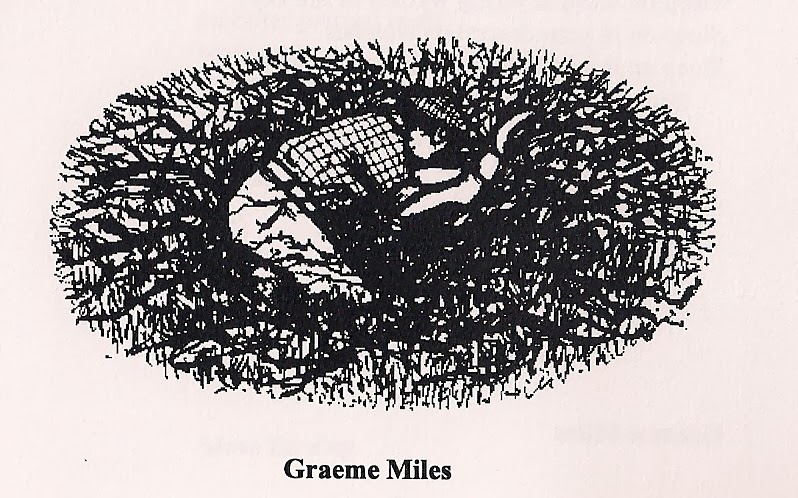
I had the great privilege of getting to know Graeme very early in my journey as a poet. Some fifteen years ago, I became a member of Jackdaw, an informal little poetry circle in Durham, which was attended by Graeme and his artistic collaborator Robin Dale. Graeme was the quiet member of the group, but his creativity was clear from the start. He was an aspiring poet, striving to write “good, bad and indifferent verse, but not necessarily in that order” (his words). He produced a series of wonderful illustrations for the first Jackdaw anthology (including the magnificent cover picture that graces this article). And it was through Robin's haunting performances of Graeme's songs that I first got to know his incredible back catalogue. Pastoral poems, work songs, chronicles of changing times: it seemed Graeme had written them all.
I had no idea how far Graeme's music had travelled until I started to venture into the idiosyncratic world of the region's folk clubs. It was a surprise to me just how many musicians – from fireside amateurs to bona-fide, touring professionals – had Graeme's songs in their repertoire. They had a natural home in north-east England, but many were known across the length of the UK (and even beyond; another exponent, Martyn Wyndham-Read, has exported the Graeme Miles songbook all the way to Australia!). I once heard Bob Fox sing The Shores of Old Blighty to a field of 10,000 people at the Cropredy Festival – and most of those 10,000 joined in the refrain.
What makes Graeme's songs special isn't just their role as sociological record. These are songs with immense heart: poems-set-to-music which are filled with love and loss, dreams of peace and hope for a better tomorrow. As a writer, Graeme was always among the people. He took on back-breaking manual labour in order to celebrate the labourers in song. He slept rough in the bitter winter of 1963. He walked the long march from Aldermaston with the original Campaign for Nuclear Disarmament. His songwriting was political, but not in any contrived or self-important way. His depiction of the wind across the North York Moors in Horumarye may have been intended to salute the timeless pilgrims of the Lyke Wake Walk; but when he sang “Cold blows the wind over Fylingdales”, it was impossible for a listener not to form a mental image of the frightening outpost of Cold War paranoia that dominated the landscape in Graeme's own lifetime. He could discuss world peace in grand allegory in The Eagle and the Dove, or through the simple dreams of a conscripted squaddie wishing for The Shores of Old Blighty.
I didn't know it at the time, but Graeme had known his share of romance, and romance gone wrong, in his younger days too. His first love song – the enigmatically titled Exercise no. 77 (only recently re-catalogued as the much more poetic Amouret) – is one of the finest pieces of romantic poetry I know. Perhaps this is one of the reasons that Graeme and I first became friends. At a turbulent time in my own private life, Graeme understood the subtext in my poetry, and encouraged me not to be afraid to express what I was feeling. He even illustrated a couple of those early attempts.
And this is where I owe Graeme a real debt. I'd only been writing poetry a couple of years when I joined the Jackdaws. But very early on, Graeme found a point of connection with my writing, and became a generous champion. I was still far from the point of actually submitting my work for publication; but it's in no small measure down to the confidence that Graeme always placed in me and my writing, that I was eventually able to do so. Perhaps it was because we shared subject matter – the natural world, love and heartbreak, occasional political comment. More likely, it was just because he was a generous, thoughtful man, keen to nurture creativity wherever he found it. He was scathing in his dismissal of the fake and the superficial. But when he found something genuine, he was passionate in his nurturing of it.
Graeme and I corresponded for several years after I left Durham, and gradually became what I hesitatingly describe as “a serious poet”. One of my most treasured possessions is the signed copy of Songscapes, his first published volume of songs, which he gave to Kath and me as a wedding present. I've watched – admittedly at a distance, but with pride and delight – as Graeme's work has attracted serious recognition (notably from the English Folk Dance and Song Society) and new generations of musicians have declared their allegiance. The Unthanks, the master reinterpreters of north-eastern traditional music, and up-and-coming rabble-rousers The Young 'Uns, are just two of the bands who have found inspiration from Graeme's work and his outlook on his art.
News of Graeme's death earlier this year was, of course, a great sadness. But it was a fitting tribute to the man and his music that his devotees were able to fill Cecil Sharp House on 23rd November for a celebration of Graeme's legacy. The Unthanks, The Wilsons, Martyn Wyndham-Read, The Young 'Uns and even Robin Dale performed a wondrous mix from the vast Graeme Miles repertoire, from the simple solo voice (Robin's haunting rendition of Exercise no. 77 still sends shivers through me) to avant-garde arrangements with brass, fiddle and sample loops of Graeme's own voice reading his poetry.
My poem, For Your Eldorado, played a small part in the proceedings. Written in 2008, and taking its title from one of Graeme's best loved songs, the poem was my thank-you for his wonderful music and for the encouragement and inspiration over the years. By a circuitous route, the poem had managed to find its way into the hands of Martyn Wyndham-Read, who judged it fitting to be shared during the evening, and contacted me out of the blue to ask for permission for it to be read out.
I probably won't ever know what Graeme thought of the poem. I sent him a copy, back when it was fresh off the printer, but we had already lost touch by this point, and I didn't get a reply. I hope he appreciated it. For now, it stands as my tribute to a generous hearted, intelligent, wise and creative writer, and a gentleman of the first order. For me, Graeme Miles was and is a poet among poets. If my creative work can in some small measure live up to the example he has set, then I’ll be a very proud man indeed.
(All illustrations in this article are by Graeme Miles and appeared in the Jackdaw writers' anthology in 2000. The text of my poem For Your Eldorado can be found at http://www.graememiles.com/lyrics.)
(For more about Graeme and his music, visit http://www.graememiles.com)
In his inimitable, quiet way, Graeme Miles is something of a local legend in the north-east of England. In a period of just over 20 years spanning the 1950s and 60s, he wrote 300-odd songs chronicling the landscape and the changing way of life in the Teesside where he grew up, lived and worked. A disciple of the Folk Revival, Graeme's songwriting was heavily influenced by the traditional music of the area. Many of his songs are shared and passed around Teesside today as if they were true folk songs, or nursery rhymes.
Graeme Miles passed away earlier this year without ever becoming a mainstream name in the arts world. He'd never have wanted such recognition. He was humble, dignified and self-effacing. For Graeme, the created work mattered far more than the creator. When traditional ways of life were coming to an end, and changing economic fortunes were dealing hammer-blows to the established industry of the region, Graeme saw his songs as his contribution to a shared heritage, a collective memory capable of withstanding the changes all around.
I had the great privilege of getting to know Graeme very early in my journey as a poet. Some fifteen years ago, I became a member of Jackdaw, an informal little poetry circle in Durham, which was attended by Graeme and his artistic collaborator Robin Dale. Graeme was the quiet member of the group, but his creativity was clear from the start. He was an aspiring poet, striving to write “good, bad and indifferent verse, but not necessarily in that order” (his words). He produced a series of wonderful illustrations for the first Jackdaw anthology (including the magnificent cover picture that graces this article). And it was through Robin's haunting performances of Graeme's songs that I first got to know his incredible back catalogue. Pastoral poems, work songs, chronicles of changing times: it seemed Graeme had written them all.
I had no idea how far Graeme's music had travelled until I started to venture into the idiosyncratic world of the region's folk clubs. It was a surprise to me just how many musicians – from fireside amateurs to bona-fide, touring professionals – had Graeme's songs in their repertoire. They had a natural home in north-east England, but many were known across the length of the UK (and even beyond; another exponent, Martyn Wyndham-Read, has exported the Graeme Miles songbook all the way to Australia!). I once heard Bob Fox sing The Shores of Old Blighty to a field of 10,000 people at the Cropredy Festival – and most of those 10,000 joined in the refrain.
What makes Graeme's songs special isn't just their role as sociological record. These are songs with immense heart: poems-set-to-music which are filled with love and loss, dreams of peace and hope for a better tomorrow. As a writer, Graeme was always among the people. He took on back-breaking manual labour in order to celebrate the labourers in song. He slept rough in the bitter winter of 1963. He walked the long march from Aldermaston with the original Campaign for Nuclear Disarmament. His songwriting was political, but not in any contrived or self-important way. His depiction of the wind across the North York Moors in Horumarye may have been intended to salute the timeless pilgrims of the Lyke Wake Walk; but when he sang “Cold blows the wind over Fylingdales”, it was impossible for a listener not to form a mental image of the frightening outpost of Cold War paranoia that dominated the landscape in Graeme's own lifetime. He could discuss world peace in grand allegory in The Eagle and the Dove, or through the simple dreams of a conscripted squaddie wishing for The Shores of Old Blighty.
I didn't know it at the time, but Graeme had known his share of romance, and romance gone wrong, in his younger days too. His first love song – the enigmatically titled Exercise no. 77 (only recently re-catalogued as the much more poetic Amouret) – is one of the finest pieces of romantic poetry I know. Perhaps this is one of the reasons that Graeme and I first became friends. At a turbulent time in my own private life, Graeme understood the subtext in my poetry, and encouraged me not to be afraid to express what I was feeling. He even illustrated a couple of those early attempts.
And this is where I owe Graeme a real debt. I'd only been writing poetry a couple of years when I joined the Jackdaws. But very early on, Graeme found a point of connection with my writing, and became a generous champion. I was still far from the point of actually submitting my work for publication; but it's in no small measure down to the confidence that Graeme always placed in me and my writing, that I was eventually able to do so. Perhaps it was because we shared subject matter – the natural world, love and heartbreak, occasional political comment. More likely, it was just because he was a generous, thoughtful man, keen to nurture creativity wherever he found it. He was scathing in his dismissal of the fake and the superficial. But when he found something genuine, he was passionate in his nurturing of it.
Graeme and I corresponded for several years after I left Durham, and gradually became what I hesitatingly describe as “a serious poet”. One of my most treasured possessions is the signed copy of Songscapes, his first published volume of songs, which he gave to Kath and me as a wedding present. I've watched – admittedly at a distance, but with pride and delight – as Graeme's work has attracted serious recognition (notably from the English Folk Dance and Song Society) and new generations of musicians have declared their allegiance. The Unthanks, the master reinterpreters of north-eastern traditional music, and up-and-coming rabble-rousers The Young 'Uns, are just two of the bands who have found inspiration from Graeme's work and his outlook on his art.
News of Graeme's death earlier this year was, of course, a great sadness. But it was a fitting tribute to the man and his music that his devotees were able to fill Cecil Sharp House on 23rd November for a celebration of Graeme's legacy. The Unthanks, The Wilsons, Martyn Wyndham-Read, The Young 'Uns and even Robin Dale performed a wondrous mix from the vast Graeme Miles repertoire, from the simple solo voice (Robin's haunting rendition of Exercise no. 77 still sends shivers through me) to avant-garde arrangements with brass, fiddle and sample loops of Graeme's own voice reading his poetry.
My poem, For Your Eldorado, played a small part in the proceedings. Written in 2008, and taking its title from one of Graeme's best loved songs, the poem was my thank-you for his wonderful music and for the encouragement and inspiration over the years. By a circuitous route, the poem had managed to find its way into the hands of Martyn Wyndham-Read, who judged it fitting to be shared during the evening, and contacted me out of the blue to ask for permission for it to be read out.
I probably won't ever know what Graeme thought of the poem. I sent him a copy, back when it was fresh off the printer, but we had already lost touch by this point, and I didn't get a reply. I hope he appreciated it. For now, it stands as my tribute to a generous hearted, intelligent, wise and creative writer, and a gentleman of the first order. For me, Graeme Miles was and is a poet among poets. If my creative work can in some small measure live up to the example he has set, then I’ll be a very proud man indeed.
(All illustrations in this article are by Graeme Miles and appeared in the Jackdaw writers' anthology in 2000. The text of my poem For Your Eldorado can be found at http://www.graememiles.com/lyrics.)
(For more about Graeme and his music, visit http://www.graememiles.com)
Subscribe to:
Posts (Atom)
.jpg)