A few years ago, the judge of one of the big poetry competitions was roundly lambasted in the literary press for a judge’s report that began “What I liked about the winning poem was its ambiguity.” Noooo, screamed the correspondents. A poem is an attempt to convey something profound to an audience. If the audience can’t grasp the meaning – if the poem is ambiguous, obscure, or open to diverse interpretation – then surely the poem has failed at the first hurdle?
I was reminded of this discussion recently. In his recently published “Top 10 Tips for Being a Successful Poet” (which are really tips for how to prepare the mind and heart so that you are in a state which is receptive to the possibility of poetry happening – a subtle but important distinction), Andrew Motion states that “people will interpret your poetry in different ways, but provided the interpretation that is brought to the poem isn’t plainly bonkers, I actually enjoy that.”
This statement elicited a strong response from my literary sparring partner Tim Ellis, who retorted: “I never write a poem unless I have something I want to say, and if people interpret my words differently I consider the poem a failure.” And that really set me thinking.
I wrestled with a similar problem earlier in my poetic career. At that time, a rather lovingly crafted descriptive poem of mine had just been Highly Commended in one of the bigger competitions. I was proud of the success. But when I read the judge’s report, I was perturbed to discover that the judge had inferred a subtext within the poem which I had never intended. The subtext he’d ‘found’ was about bereavement – not exactly a minor issue. In fact, owing to the subject matter of the poem, I was initially a little upset to realise that the judge had interpreted it this way.
What followed was a bit of a crisis of confidence about my integrity as a poet. After all, aren’t poets supposed to tell the truth, at least as they perceive it to be? If people were reading my poem as a poem about bereavement – if, indeed, it had won its competition place on the strength of an assumption that it was about bereavement – then wasn’t there something intrinsically dishonest about the poem? And wouldn’t there be something even more dishonest about me putting the poem forward in future poetry readings, knowing that at least some of the audience were likely to interpret it that way?
It took a very wise poetry tutor to explain to me that that didn’t mean the poem (or the poet) wasn’t truthful. The very fact that the poem was open to an interpretation other than the one I’d intended was a sign of the power of the poem to take on a life beyond the person who had written it. Those who subsequently read, or heard, the poem were free to draw out meanings from the poem which resonated with them. The poem was no longer constrained by the fairly narrow sphere of my own observations, thoughts and feelings; it could land in somebody else’s heart and have a whole new meaning for them, independently of me. And that, if I’m honest, was something a little bit awe-inspiring, and very humbling.
This is exactly the same reason I love modern art, and folk music. In both of these art forms, there’s seldom an obvious contemporary meaning to the artwork. Modern art and traditional songs and stories are at their most powerful when their meaning isn’t tied to the person who created them. Other people can come and interact with and, to an extent, reinterpret the artwork. Thus, fairy tales take on new meanings which resonate with the concerns of the contemporary society. The tales of King Arthur have been constantly rewritten for the changing times, from the age of high chivalry in Malory, through the vehement anti-war satire of TH White, to Monty Python’s surrealist whimsy. We are far more aware of the undercurrent of, say, sexual violence in Little Red Riding Hood or domestic abuse in Cinderella than were the audience of fifty years ago, or a hundred. And one reason why I love the Yorkshire Sculpture Park so much is that the Henry Moores and Barbara Hepworths there can be touched, climbed over, peeked through and hidden behind; their meaning is constantly reinterpreted by children of all ages finding new ways to interact with these magnificent sculptures, new games to play with them.
For me, a really good poem has a similar quality to those stories and sculptures. It can also be played with by the reader, or listener. They can see aspects of their own lives, or their landscape and history, in a new light by seeing them through the poem’s lens. So there doesn’t have to be one, absolute, inviolable meaning to a poem for it to be a success. Even an overtly contemporaneous political rant, if well written, can resonate long after the events which incited the poet to put pen to paper have become yesterday’s news. Goldsmith’s The Deserted Village was written in response to the effect of the Enclosure Acts on rural populations, but the workers of mischief in the poem seem disturbingly familiar in an age of austerity, benefit cuts and food banks.
There has to be some meaning though. There are poets who take ambiguity to an extreme, and produce poetry so obscure that no one can dig out any meaning from their words. Or, perhaps worse, only those with doctorates in literature can decipher them. Ambiguity as a poetic tool fails when its effect is to exclude the readers, instead of inviting them in.
Unfortunately, judging by the content of certain journals I could name, there are still one or two poetry editors who haven’t realised this...
Showing posts with label tim ellis. Show all posts
Thursday, 30 October 2014
Saturday, 28 September 2013
Where have all the war poets gone? Part 1
My friend and poetic sparring partner Tim Ellis sparked off yet another cracking Facebook debate a couple of weeks ago. In a discussion of his e-book On the Verge – an elaborate satire on the Western world's disregard for the consequences of environmental degradation – he asked the question: why were there so few poets writing about climate change? Are we afraid to tackle the subject? Or are we more comfortable disregarding the issue altogether, and writing about ‘safe’ subjects like love, daffodils and cats – thus proving the truism that most people ignore most poetry because most poetry ignores most people?
Tim has a point. Very few of the poets I know in Yorkshire are writing about climate change – or Syria, homelessness or benefit cuts. Those few that are overtly engaging with these issues seem to be writing rants, rather than poems – shouty tirades that fail to have any real impact. The bona fide poems are conspicuous by their absence.
I felt duty bound to play devil's advocate. It wasn't, I protested, that we didn't want to write about such things. The difficulty is that for most of us, war and homelessness and climate change are subjects too big to write about. Is it even worth the poet's effort trying to write about such things, when any given 30-second run of newsreel images makes our months of laboured word-craft pale into insignificance? Isn't it better to write about love, and daffodils, and cats, because these things at least give us a moment's escape from the ugly realities of the world?
I don't really believe this theory. Poetry is the stuff of human life. Poets, as a class, have a sort of responsibility to humanity, to reflect and recount all of human life. We need poets who write about climate change, and war, just as much as we need poets who write about love (or cats). Poets, collectively, are failing the world if we decide that any subject is not fitting subject matter to write poetry about.
So why do so many of us find it so hard to write poems about ‘big issues’ – or make such a bad job of it when we do try?
War and climate change are pretty unsubtle things. So there is a tendency, when addressing them head-on, to think that ‘subtle’ isn’t good enough. Why write a sonnet, when you can have a rant instead? But rants on their own are an artform more akin to Party Political Broadcasts than to poems. I'm not saying they don't have their place. Someone needs to get up on the barricades and say what the rest of us are feeling. But it doesn't require poetry to do that. Rhetoric, yes. Oratory, probably. But poetry? The subtlety of poetry is just going to be lost on an angry mob.
So what can poetry do to illuminate, inform and educate about the big issues?
In my opinion, poetry has two qualities that newsreel footage and mob rants don't have. Firstly, poetry is a way of looking slant-wise at the world – of finding meanings and connections that we never realised were there. By looking at something slant-wise, we end up looking at it more deeply – understanding its inner workings, its relationship to the wider environment. We find the new angle that the news reporters and the propagandists miss.
Pete Seeger's Where have All the Flowers Gone? is a prime example. One of the greatest anti-war songs ever written; but it never goes near a battlefield. Its starting-point is the cycle of life and love, as young girls pick flowers to be reminded of their sweethearts. It ends up in the graveyard where all their sweethearts are buried, without us quite noticing how we got there – and then the whole futile cycle starts again.
The second thing that poetry does is to use the microcosm to tell us about the macrocosm. A war poem doesn't tell us about ‘war’ – ‘war’ is too big, too abstract and too grotesque a concept to be pinned down in a 14-line sonnet. But a Wilfred Owen poem can tell us about a single, heart-stopping moment of terror in the life of a single soldier. And it's when we grasp the notion that this awful moment was replicated tens of thousands of times over, in the lives of hundreds of thousands of people, that we begin to feel the true horror of the war. When we see its discarded left-overs picked over by the ragmen in Patricia McCarthy’s Clothes that Escaped the Great War – the 2012 winner of the National Poetry Competition – those of us who have been fortunate never to have experienced such desolation can at least begin to grasp the awful emptiness, the futility of what was left behind.
There is an even subtler way that poets can be war poets, or climate change poets. A good poem has many layers. The subtext of a poem often carries a meaning that goes far beyond the subject matter in the written words. Love poets (and love-gone-wrong poets) use subtext all the time, to turn a physical description into an emotional map of the human heart. A whole generation of literature students are currently writing theses on the existential significance of William Carlos Williams' wheelbarrow. So what's to stop a poem about a love affair, a cat, or even a daffodil, also being an unwritten commentary on the folly of war, or the depredations of global warming? All it takes is for poets to be made aware of the possibilities.
Sunday, 10 March 2013
Pretentious poets

I'm not convinced that performance poet Tim Ellis will thank me for name-checking him at the start of a blog post headed "Pretentious Poets." But it's thanks to him that I'm writing this post. Tim and I have different poetic backgrounds and interests, which has made for some lively online debates in the past couple of years. While we often disagree about specifics, we mostly keep a healthy respect for the other's point of view.
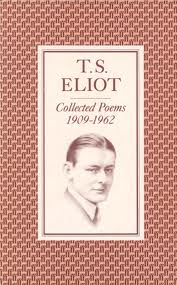
But I cannot, ever, agree with Tim that the work of TS Eliot deserves to be consigned to the poetic dustbin.
I should add that Tim is one of the least pretentious poets I've ever met. As a writer he's a genius of rhyme and rhythm; as a performer, he was a worthy winner of the 2011 York Poetry Slam, for which I was part of the judging panel.
As I understand it, Tim's take on TS Eliot is this. TS Eliot is a pretentious poet. Much of his work is so thick with obscure allusions to ancient Greek and Roman civilisation that it's impossible to find a way into it unless you have a higher degree in classical literature. And, surely, any poetry that is this hard to understand just adds fuel to the argument that poetry is something that's disconnected from reality, and simply not worth bothering with.
I have a lot of sympathy with this argument – and it's one that has made me think about why I first started writing poetry. I came to poetry relatively late in life, following teenage years filling bookshelves full of ring binders with really bad novels of epic proportion. My poems started life as stories that I was trying to tell: some to fathom out the problems of the world or the complexities of the people around me; others, simply to capture the mood on one particular day or in one special place. "Art", for its own sake, was practically non-existent in my list of priorities.
Accessibility is always really important if you're trying to tell a story. And it's the same with my poetry. If people don't get what my poems are going on about, then on some level the poem hasn't worked.
The trouble is, other poets don't write for the same reasons that I do. There are many who write for no other reason than the joy of artistic expression. They don't necessarily need an audience; and when they get one, it may not matter if not everyone in the audience can understand what they're going on about.
Which brings me back to TS Eliot. His approach to poetry was in many ways the polar opposite of mine. Yet, when I blogged awhile back about "The Ten Poems that Changed my Life", The Waste Land was one of the poems I listed.
There is something magical for me about this poem. Eliot's ability to draw scenes and atmospheres, to get deep into the guts of his characters' (and his readers') dreams and fears, and the sheer musicality of his free verse – all these things weave a sort of spell about me. It doesn't matter that three-quarters of the classical allusions go straight over my head. Somehow The Waste Land bypasses my head and echoes inside my gut in a way that few poems have ever done.
Four Quartets, by contrast, leaves me cold. The layers of classical and artistic reference are so thick here that to me they're completely impenetrable. There's nothing I can latch on to or identify with. The atmospheric quality of The Waste Land is missing, the rhythm and musicality of the words seem to be lacking too. Its philosophising is abstract, self-indulgent. It makes no connection with me and sheds no light whatsoever on the world around me.
There seem to me to be a lot of poets who have been encouraged to write in a way reminiscent of what Eliot does in Four Quartets. The end result is to daze the reader with intellect. This can be done very cleverly; even though I don’t understand the end result of Four Quartets, I can at least tell that there's a master craftsman at work. Mostly, though, it just seems insufferably smug.
If there is a huge intellectual hurdle to be overcome before you can appreciate poetry, to me it is not good poetry, no matter how many awards it wins. Outside the rarefied atmosphere of literary circles, the misconception that 'serious' poetry is something too snobbish for the average man or woman in the street is still one that's all too common. And any poet dead set on propagating that misconception is going straight into my personal rejection bin. They're not telling a story. They're not even enchanting their readers with a glimpse of a dream. To put it bluntly, all they are doing is showing off how clever they are.
I'm really, really proud that there so many good poets on the Yorkshire scene who show that it is possible to be serious about your poetry without it becoming pretentious. The poetry world doesn't need another TS Eliot; one is quite enough, thank you very much. If a few regulars in the learned poetry journals could learn to be a bit less TS Eliot and a bit more Tim Ellis, they'd be doing all of us a favour.
Sunday, 13 November 2011
Purple Patch's Best Small Press Poets of 2011 - some thoughts
I like to think I'm reasonably good at spotting genuine talent when it comes to poetry. By "talent" I don’t mean "a combination of wilful obscurity and intellectual pretension", unlike the people who run certain poetry presses I might care to mention. I mean a genuine understanding that words, properly handled, are like music. An ability to make unusual and improbable connections between the world of the physical senses and the inner world of emotions, thoughts and dreams. And a certain fearlessness – a willingness to take the risk of speaking out against the prevailing opinions and fashions of the time, confronting the abusers of power and taking a stand for what they believe to be right.Every now and then I get a little vindication. Back in 2005, when I judged my first poetry competition, I awarded the First Prize to a new poet on the scene named Kate Rhodes. Ms Rhodes has since appeared in the Forward Prize annual anthology more than once – a sign that she has written (and continues to write) some of The Best Poems of the Year.
This year's Purple Patch list of the Top 20 small press poetry collections was a particular source of delight. Purple Patch, for those who don't know it, is a fiercely independent poetry journal that has been going since 1976. It has a well-earned reputation for not following trends and fashions and for championing what it likes; and it is respected for sticking to its principles. Every year Purple Patch produces a "Best Of" list to recognise poets who pass under the radar of the literary "establishment" – usually poets published by small presses that wouldn't merit a mention in the Grauniad or the TLS. And this year there were not one, nor two, not even three, but four of "my" poets in the Top 20 Best Individual Collections list.
In that respect, I have something in common with Purple Patch. I spend a lot of my time trying to support and promote poets and writers who haven't had a chance in the world of corporate literature. I don't publish journals or anthologies; I don't run festivals or big, Arts Council-funded events programmes. But in my own small way, through open mics, performance nights, poetry slams, and hopefully in the near future the odd masterclass or two, I do what I can to help good local poets get their work across to a wider audience. They deserve it. Their work is every bit as good as what I can browse on the poetry shelves in Waterstone's (and a million times better than most of what's on the internet).
The fact that four – that's a whole 20% – of this year's Purple Patch Top 20 collections have come out of the York-and-the-north-east poetry scene which means so much to me, is confirmation of the fact that I'm not crazy. These people are actually bloody good.
I've worked with the No. 9 poet, Rose Drew, many times over the last five years. We've critiqued each other's efforts at getting a first collection into print (she got there way before me). There's a passion and gutsiness and a carefully controlled anger about her work that makes her a formidable live performer and a creator of startling imagery.
Tim Ellis, at No. 20, was one of the first poets I booked as a guest feature at Speakers' Corner. He's another first-rate performer; he might shock an audience by leaping around the stage pounding a bongo drum, or quietly captivate with poems of unexpected poignancy. His work is full of humour and colour, filled with an unashamed political and environmental consciousness, and he's one of the best contemporary rhymesmiths I've heard.
Miles Cain has only been writing poetry a few years. He became extraordinarily good, extraordinarily quickly. I had the unexpected honour of being acknowledged in his debut collection, The Border, which appears at No. 8. There are poems in this collection which I recognise from their infancy, as experiments with words and thoughts. The fact that they have crystallised so memorably – and this is a collection that's bursting with memorable images – is testimony to the dedication and hard graft Miles has given his art.
My fourth “Top 20” poet, Katie Metcalfe (at No. 15) is the youngest of the set, and perhaps the most visionary. Katie is an indefatigable poet, blogger and literary editor (she's the founder of Beautiful Scruffiness magazine, about which I've blogged before). It'd sound terribly patronising to call Katie a young writer – perhaps "pre-middle-aged" will distinguish her more accurately from my own generation! – but it's surely a sign of hope in a depressed age that a writer who clearly has so many more good writing years in her is finding the poetic soul in the recession-hit north-east of England, and making something almost mythic out of it.
All four of these debut collections are near the top of my review pile, and the Soapbox will be reporting on them in detail in due course. For now, I'll offer my official congratulations to Miles, Rose, Katie and Tim. You've made a cynical poet very proud – and convinced me all the more that this sometimes thankless passion that we share is still worth shouting about.
Subscribe to:
Posts (Atom)